

Fast and Slow
How long has it been since you seriously wrote a long piece? As the internet erodes our personal time, I rarely write with care anymore. The last time I felt inspired, I was caught off guard by the realization that I was on the verge of losing my ability to write. The more I couldn't write, the more anxious I became, and the more I wanted to finish quickly, leaving my drafts folder piled with unfinished pieces from years ago. I want to first explore the "fast" and "slow" of writing.
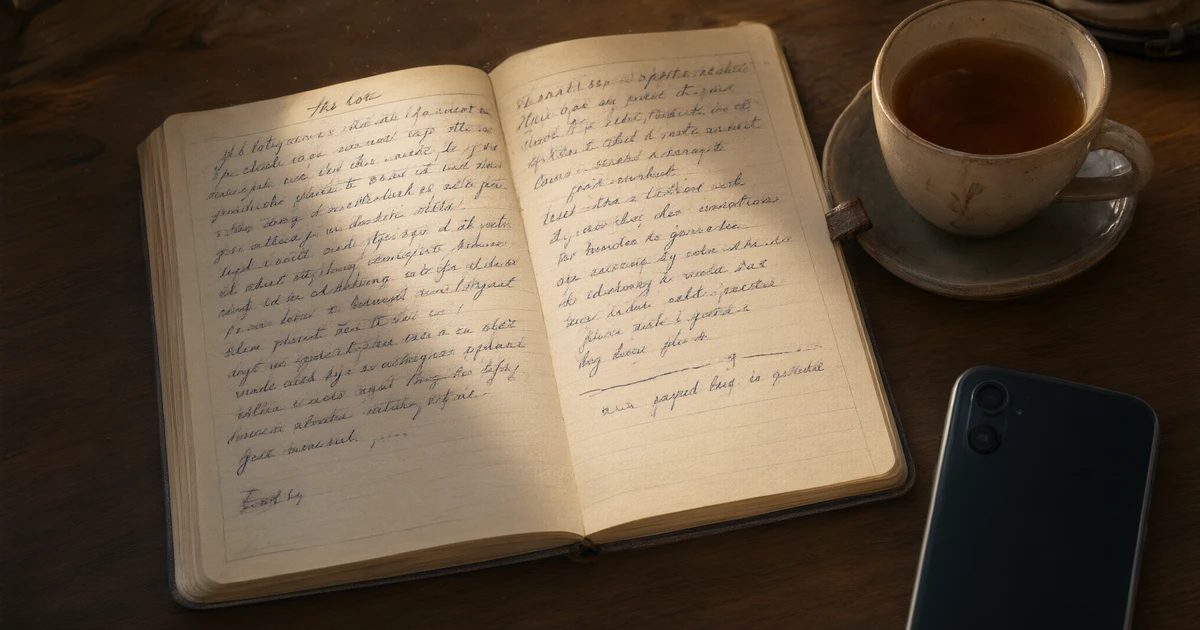
Start by writing an article
How long has it been since you seriously wrote a long article? Take me as an example: as the internet and social platforms erode my personal time, I rarely spend time carefully writing anymore. The last time I had a sudden urge to write an article, during that process I vaguely realized that I was almost losing my ability to write. Written expression has gradually become colloquial, and it is hard to use precise words to express my inner thoughts; my thinking is also unclear, and I write whatever comes to mind.
As an internet professional, my limited writing experience has mainly consisted of producing technology-related articles. When creating such articles, I consciously express things in a structured way: I write a good outline and then fill in the content. I used this a lot in my past career. But when it comes to personal thoughts and reflections, as well as life-related expression, I have done very little—one could even say none. How to accurately, restrainedly, and objectively express one's inner thoughts and emotions is not an easy thing. Technology can be deconstructed and summarized step by step and method by method, but moods are very hard to describe with a formula.
The more unable I am to write, the more anxious I become inside, and the more I want to finish this task early. A very typical phenomenon is that before writing even a little content, I look back to see how many words I have written, and then revise back and forth, causing me to spend a lot of time yet still not finish. I often lack the patience to do this one thing, which leads to many unfinished drafts. Now my drafts box is full of drafts written several years ago: some have only a title, some have only the background and setup, some have just the title of the main body, and some are missing an ending. In a sense, I am not suited to writing this kind of article, or rather, I am an irresponsible person.
“Why does writing end up unfinished?” Every time I think of this topic, I fall into self-doubt: why is it so hard for me even to write an article? Am I really this bad now?
If I were to dig deeper into the reasons, many reasons could probably be found, but in this article I want to first discuss the “fast” and “slow” of writing.
The Fast and Slow of Writing
I must have been using AI too much, which is why I got the illusion that writing should be as simple and fast as AI's token generation.
AI can output thousands of words in a minute, so no matter how bad a person is, they shouldn't go several days without being able to write an article, right?
Thinking back on it, is writing something that can be done mindlessly, with inspiration gushing out anytime and anywhere? When did the illusion that "writing is an easy thing" arise?
Although the speed at which the internet produces content is constantly accelerating today—it wouldn't be an exaggeration to call it exponential growth—especially now that LLMs are so prevalent, a prompt of just a few words can make an LLM produce thousands of words of a flawless essay, and as long as you want, it can generate an article of any length.
Machine writing is undoubtedly fast, but humans are not machines.
For me, writing is about thinking repeatedly, stringing together the ideas scattered all over my mind and weaving them into a story. I need to constantly search my mind for ideas that once flashed through it, or recall all kinds of fleeting memories from the past, capture these contents one by one, and carefully organize, polish, translate, and summarize them. So this process is naturally slow; there's just no way to make it fast. And from the perspective of the goal, "fast" itself is not the purpose of writing.
The same problem doesn't only happen in writing, and I think it doesn't only happen to me either.
The Fast and Slow of Reality
We live in an era of extremely rapid development, and against this backdrop, many kinds of "fast" in real life have been spawned.
In life:
- A 40-episode TV drama's plot is too slow, so I watched the whole thing at double speed
- A two-hour movie in the cinema is too long, so it's easier to just watch clips and commentary on Douyin
- A 400-page book is too thick; after reading for two days I still hadn't finished it, so I just asked AI for a summary and notes
In relationships:
- After knowing each other for a week, they publicly announce they're dating; after a year of dating, they're ready to get married; after getting married, they start trying to have a child
At work:
- The boss says a competitor has launched a certain feature, and we need to hurry up and copy it. The PD says this is a requirement mandated by the boss—develop today, submit for testing tomorrow, go live the day after tomorrow. There's no time to write a requirements plan; anyway, it's just one sentence.
- The project kick-off meeting has just ended and we're already sprinting. The PM says progress is too slow—we need agile development, speed it up even more, one release per week.
- Product goals are updated monthly; launch this week and results are expected next week. Product strategy increasingly pursues short, flat, and fast.
Companies that control traffic and core technology are also chasing speed:
- The official traffic incentive policies of content platforms keep changing; only by publishing content faster and more frequently can you gain higher exposure and traffic support.
- In the AI world, models are updated extremely frequently—major versions every two months, minor versions every two weeks. It's like celebrating the New Year every day; last year's models are already nowhere to be found and attract no attention.
In this enormous social vortex, you, I, and everyone else are all swept up in it, churned until everything is turned upside down. If you have a strong sense of responsibility, then unfortunately, anxiety and depression will most likely gradually appear in you.
Real society is developing rapidly, but there are indeed some things that cannot be rushed:
- Learning and mastering a sport, a language, a musical instrument, a technical framework
- Developing a habit
- Building systematic knowledge
- Improving judgment and depth of thinking
- Even the most basic thing: carefully finishing reading a book
Only by seriously engaging in the above matters will you understand why these things cannot be rushed. In the short term, you can indeed learn some techniques to accelerate learning, but without a solid foundation, no amount of techniques will help. At least for the current human brain, these things cannot yet be learned and mastered quickly.
A rapidly developing society is gradually coming into constant conflict and contradiction with certain "slow actions" of people. It seems that slowing down is a burden—you can't afford to "slow down," and you worry that if you slow down, you'll be surpassed, overtaken, and abandoned.There is less and less time to cultivate flow, and more and more fragmented time is consuming you in "faster" and "shorter" ways. Life is becoming increasingly "fast-foodized."
The "fast" and "slow" that modern people need
There was a period when I liked to immerse myself in the "busyness" I had fabricated for myself, busy doing many things, every one of them important, rarely lifting my head to think about the problems within it all, and most of the time responding to everything by inertia. Because there was too much to do, when time was limited I would prioritize handling things in a "fast" way, and because I had no time to think about which things should be "fast" and which should be "slow," I treated them all as "fast."
The price of this is that the people around you will drift further and further away from you. No, rather, you will drift further and further away from the people around you.
I need to slow down. I need to think. I need to slow down and take the time to think.
Since time and energy cannot be changed, "fast" and "slow" are not a one-size-fits-all binary choice, but rather slowness within fastness and fastness within slowness.
When should you be "fast":
- Keeping up with celebrity gossip
- Learning about things in fields you are not interested in
- Things you should know but that are not that important
When should you be "slow":
- Systematic learning and understanding
- Personal summarization and review
- Making major decisions
Fastness cultivates efficiency and high-density information intake. Slowness cultivates focus, flow, and continuous accumulation. What matters is combining fast and slow, with proper tension and relaxation, keeping yourself in a state of ease and mastery.
Postscript
This was originally an article written in November of last year, and it sat in drafts the whole time; after starting a draft that day, I never touched it again. Now I suppose I am gradually paying off my debts, filling in the pits I dug for myself.
There is a book that introduces the fast and slow of thinking:
The core of Thinking, Fast and Slow is: human thought roughly operates through two systems working together.System 1Fast, intuitive, automatic, good at everyday judgments, but easily influenced by bias;System 2Slow, rational, effortful, responsible for complex calculations and deliberate decisions, yet often lazily defaults to accepting System 1's answers.Through a large number of psychological experiments, Kahneman shows that people are not as rational as they imagine themselves to be. We are influenced byanchoring effect, loss aversion, availability bias, overconfidence, framing effectand other such influences, we often misjudge probabilities, risks, and causal relationships.What this book is really trying to say is:Intuition is very useful, but not always reliable. When facing important decisions, you should be aware of your own cognitive biases and, at the right moment, engage slower, more rigorous thinking.—- ChatGPT
A large part of my views and thinking comes from this book. But the difficulties I have encountered over the past two years have been more about how to "slow down." In the process of seeking my own "flow," writing out my thoughts and experiences always feels like it will help me achieve my goals more effectively.
So if this article is fortunate enough to offer readers some inspiration, I would be immensely honored; and if readers hold different views, I think that is entirely reasonable as well. What matters is that we have all been thinking in this process, haven't we?